Same Micro-Credential.
Different Starting Points.
Imagine ten people enrolling in the same IKON SKILLS™ Micro-Credential at exactly the same time. They all have the same 10 Core Competencies to master. The benchmark is the same for everyone: 75% proof of competency before the credential is awarded.
But here is the key insight from neuroscience: no two human brains arrive at the same place. One learner may already know three of the ten competencies well. Another may be completely new. A third speaks English as a fourth language. A fourth learns best through stories and real examples. A fifth has strong technical skill but has never been formally assessed before.
Traditional learning ignores all of this. It delivers the same video, the same quiz, the same experience to everyone and calls it "education." IKON SKILLS™ does something completely different. It maps the mind before the first lesson begins.
Same Start Time. Ten Different Brains.
All ten begin at the same moment. The AI engine immediately begins profiling each one before teaching a single word.
Each of these ten practitioners gets a completely different experience, even though they are learning the exact same Core Competencies. Here is why this is not just a feature. It is a reflection of how the human brain actually learns.
What neuroscience tells us about
How people learn
Learning is not a simple transfer of information from a screen to a brain. The brain has to receive, process, connect, and store new knowledge. Neuroscience shows us that this process looks very different depending on who the learner is.
Prior Knowledge Shapes Everything
The brain stores new information by connecting it to what it already knows. This is called schema theory. If a learner already knows something about the topic, the new information is absorbed much faster. If they know nothing, the brain needs more time and more examples before the connection is made.
The IKON SKILLS™ pre-test reads the learner's existing knowledge before anything else.
The Zone of Proximal Development
Psychologist Lev Vygotsky showed that people learn best when they are taught just beyond what they already know, but not so far that they become lost. Too easy, and the brain switches off. Too hard, and the learner gives up.
The AI engine finds this exact zone for each individual practitioner and stays there throughout the learning journey.
Working Memory Has a Limit
The human brain can only hold a small amount of new information at one time. This is called cognitive load theory. If a learner is overwhelmed with too much content at once, learning fails.
The AI engine paces content delivery to match each practitioner's cognitive bandwidth, not a fixed content schedule.
Emotion and Relevance Drive Memory
The brain's memory center, the hippocampus, works closely with the emotional center, the amygdala. Learners remember information much better when it is connected to real-life examples that feel relevant and meaningful to them. Generic examples fade. Personal, contextual examples stick.
IKON SKILLS™ delivers real-life scenarios matched to each practitioner's context.
The Spacing and Retrieval Effect
Neuroscience research consistently shows that we retain knowledge far better when we are tested on it, rather than just reading it. This is the testing effect. Additionally, spacing practice over time builds deeper memory traces.
The IKON SKILLS™ formative assessment loops do exactly this: they repeatedly retrieve knowledge and reinforce it at the right moments.
Feedback Closes the Learning Loop
When the brain receives immediate, specific feedback after a response, it can correct its own patterns. This is how neural pathways are strengthened. Vague feedback does very little. Precise, timely feedback changes learning outcomes dramatically.
Every assessment in the IKON SKILLS™ system is followed by targeted feedback, not just a score.
This Is What Happens Inside Every Competency
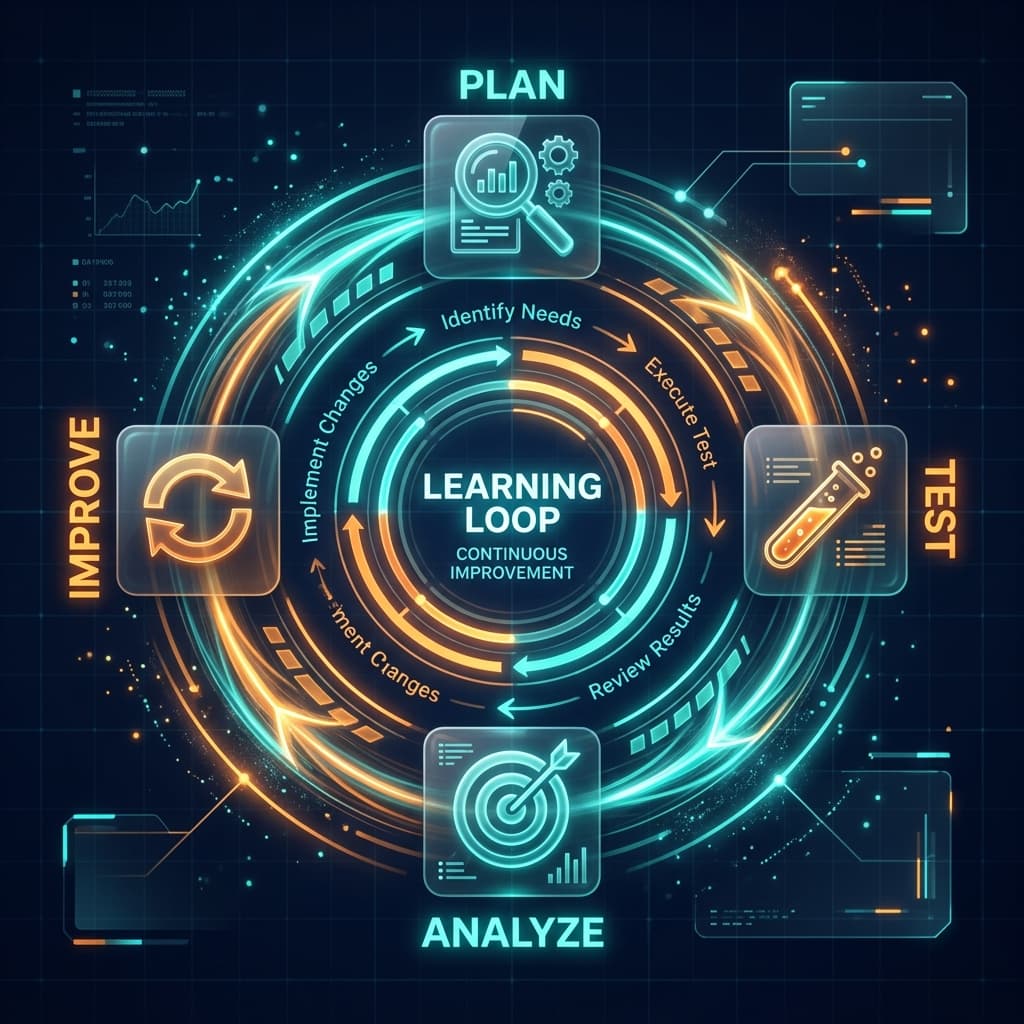
Each of the 10 Core Competencies within a Micro-Credential follows this learning loop. The loop repeats until competency is proven at 75%. There is no shortcut. There is no skipping ahead.
PRE-TEST
The AI checks what the practitioner already knows. No assumptions. Clean baseline.
PERSONALIZED TEACHING
Content, language, examples, and depth are matched to this learner's level in real time.
FORMATIVE ASSESSMENT
A diagnostic check; not to grade, but to understand what the brain has absorbed and what gaps remain.
REINFORCEMENT
Gaps are addressed immediately. The concept is re-taught differently, not repeated the same way.
VERIFIED MASTERY
75% competency proven. Only then does the practitioner move to the next Core Competency.
This loop is not just a system feature. It mirrors the natural learning cycle of the human brain: encounter, process, test, correct, consolidate. Skip any step, and learning becomes shallow. Run all steps, and the learner builds real competency that lasts well beyond the assessment.
Teaching Until the Brain
Actually Gets It
Jerome Bruner's Concept Attainment Model is at the heart of how IKON SKILLS™ teaches each competency. The idea is simple: a learner truly understands a concept only when they can identify what it is, what it is not, and apply it in a new context.
This is different from memorizing a definition. A practitioner who has memorized what "active listening" means may completely fail to demonstrate it when asked to apply it in a difficult workplace scenario. IKON SKILLS™ teaches the concept, tests recognition, then tests application in real-world contexts.
Real-Life Examples
The AI selects examples from contexts that are relevant to the practitioner's region, industry, and role. A practitioner in Kenya sees different examples than a practitioner in Nepal, even when learning the exact same competency. The concept is the same. The context is personal.
Language-Level Matching
As the practitioner responds and interacts, the AI continuously reads the vocabulary, sentence complexity, and conceptual language being used. Teaching materials adjust to this level in real time. A learner who writes at a simpler language level is not left behind.
Learning Style Adaptation
Some learners grasp concepts through logical sequences. Others need a story first. Others need to see the concept broken down step by step. The AI identifies patterns in how each practitioner responds and adapts the teaching style accordingly. This is data-driven personalization.
The AI Knows You. From the First Response.
From the moment a practitioner begins their Micro-Credential, the AI engine is doing far more than teaching. It is building a deep, dynamic profile of that specific learner. This profile grows richer with every interaction.
Language Fingerprint
Every person writes in a way that is uniquely theirs. Vocabulary choices, sentence construction, response patterns, and even the way they express uncertainty, all create a recognizable signature. The AI records this from the very first interaction.
Knowledge Baseline
The pre-test establishes what the practitioner knows before instruction begins. This baseline is stored. If the quality of responses suddenly jumps beyond what the baseline would predict, the system flags this as an inconsistency.
Behavioral Consistency
The AI monitors the pace of responses, the nature of errors, and how the learner navigates difficulty. A practitioner who consistently struggles does not suddenly produce flawless academic language without reason. Patterns matter.
Academic Integrity: Why copying from another AI does not work
Some learners may attempt to copy a response generated by another AI tool on a separate device and paste it into the IKON SKILLS™ assessment. Here is why this strategy fails, not because of a simple plagiarism checker, but because of how deeply the AI understands the practitioner.
By the time a practitioner reaches an assessment question, the AI already has a detailed profile: how this person writes, what vocabulary they use, how they structure ideas, and what gaps they have shown. A response generated by a general AI tool will almost certainly not match this established profile. The language will be too formal, too structured, or too advanced. The AI engine will detect this inconsistency immediately.
Furthermore, the assessment questions themselves are algorithmically personalized.They are drawn from a question bank and sequenced based on the specific learner's progress. A general AI tool without access to this context cannot generate a contextually accurate answer.
This is not a system trying to catch cheaters after the fact. It is a system that knows each learner so well that inauthenticity becomes visible the moment it appears.
Why 75% Proven Competency
Means Something Real
A certificate that says a learner watched a video and answered a multiple-choice quiz does not prove competency. It proves that someone completed a process. That is not the same thing.
The IKON SKILLS™ binary verdict, Competent or Not Yet Competent, is grounded in a principle that is both neuroscientifically sound and professionally meaningful: a learner should only be declared competent when they have demonstrated, repeatedly and consistently, that they can apply the skill in varied contexts.
The 75% threshold is not arbitrary. It is a minimum proof-of-mastery benchmark. It means the practitioner has correctly applied the competency across the required range of questions and scenarios, not by luck, not by guessing, but by demonstrated understanding.
When an employer or institution sees an IKON SKILLS™ Micro-Credential, they are not looking at a certificate of attendance. They are looking at documented, AI-verified, loop-tested proof that this specific practitioner has demonstrated competency in each and every one of the 10 Core Competencies at a 75% benchmark. That is a credential that means something.